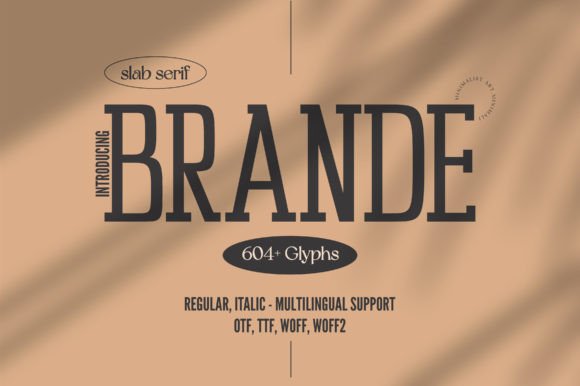
Brande: The Slab Serif That Bridges Modern Minimalism and Timeless Class
Typography is the voice of your visual identity. Long before a visitor reads a headline or a customer scans a product description, they feel the typeface. In a crowded digital landscape where attention spans are shrinking, the choice between a rounded, friendly sans serif and a sharp, authoritative serif can dictate whether a brand feels playful or permanent. This is where the concept of "voice" becomes critical. You need a font that doesn't just sit there looking pretty, but one that actively communicates the values of your project—precision, clarity, and a sophisticated edge. If you have been searching for that specific aesthetic that balances structural integrity with high-end elegance, it might be time to look at the tall, condensed silhouette of a specialized display typeface.
The Anatomy of Authority: Why Condensed Slab Serifs Work
There is a specific category of typography that commands attention without shouting. It relies on verticality and clean geometry to create a sense of stability and modernity. This is the realm of the condensed slab serif, a style that has seen a massive resurgence in contemporary design. Unlike the heavy, blocky slab serifs of the 19th century used for circus posters, the modern interpretation—exemplified by Brande—is refined. It strips away the unnecessary ornamentation, leaving behind sharp lines and intentional curves.
What makes this style so effective for modern branding? It comes down to space efficiency and hierarchy. A tall, condensed typeface allows you to pack a visual punch in a small footprint. Think about a website hero section or a packaging label; vertical space is often at a premium. A font like Brande allows you to use large, impactful headlines that don't break the layout. It creates a rhythm on the page that guides the eye downward, making it incredibly effective for lists, menus, and editorial layouts.
Practical Applications: From Logos to Packaging
When we talk about applying a premium font to real-world projects, versatility is the golden standard. You want a typeface that looks as good on a tiny favicon as it does on a billboard. Brande’s "sleek and refined" nature makes it a workhorse for various creative industries.
For logo design, the sharp lines of this typeface are ideal for industries that rely on trust and structure. Imagine a boutique architecture firm, a high-end fashion label, or a modern artisanal coffee roaster. The font provides an immediate sense of "established" and "curated." Because it is a slab serif font, it carries a weight that sans serifs sometimes lack, yet the condensed form keeps it from feeling heavy or dated.
In packaging design, readability is king, but shelf appeal is the queen that gets the product picked up. A condensed font allows for more information to be stacked vertically on a bottle or box, which is a common layout requirement for wine labels, cosmetic bottles, and gourmet goods. The clean, minimalist design of Brande ensures that even when stacked, the letters don’t bleed into one another, maintaining that crucial legibility at a distance.
Elevating Digital Spaces: Web and Social Media
The digital realm demands a different kind of performance. On websites and blogs, load times and screen resolutions vary wildly. A well-crafted display font needs to render crisply on high-definition retina screens without looking jagged on standard monitors. Using a font like Brande for your H1 and H2 headers can instantly upgrade a standard WordPress theme into something that looks custom-coded. It adds a layer of professional polish that generic system fonts simply cannot provide.
For social media graphics, the challenge is stopping the scroll. Platforms like Instagram and Pinterest are visual battlegrounds. You have milliseconds to convey a message. Brande’s "tall and condensed" nature is perfect for overlaying text on images because it leaves plenty of negative space around it. This creates a contrast that makes the text pop against a busy background photo. Whether you are creating quote cards, sale announcements, or story headers, the sharp lines ensure your message is the focal point, not the background noise.
Matching Typography to Project Goals
Choosing a font isn't just about what looks "cool" in the moment; it is about alignment with your project goals. If you are a small business owner or an entrepreneur, your typography must support your brand identity.
- For the Minimalist Brand: If your aesthetic is "less is more," Brande acts as a statement piece. You don't need elaborate graphics; the font itself becomes the design element. Pair it with a simple sans serif for body text, and you have a complete visual system.
- For the Luxury Market: Luxury is often about restraint. The refined curves of a creative font like Brande suggest exclusivity. It works beautifully on dark backgrounds with light text (white or gold) for editorial design and lookbooks.
- For Event Branding: If you are designing invitations or merchandise for an event, a condensed serif adds a sense of formality without being stuffy. It feels celebratory yet structured.
Mastering Font Pairings and Hierarchy
A common mistake in design is using a single font for everything. While Brande is versatile, it shines brightest when paired correctly. As a display font, it is meant for headlines, sub-headers, and callouts.
To create a balanced font pairing, you need contrast. Since Brande is tall and has serifs, your body copy should ideally be a sans serif with a wider stance and a lower x-height. This contrast ensures that the headline grabs attention (using Brande), while the body text remains easy to read over long paragraphs (using a sans serif). Avoid pairing it with other condensed fonts or overly decorative script fonts, which can create visual clutter. The goal is clarity.
Consider the hierarchy of your information. Use the bolder or heavier weights of Brande for your main value proposition. If the font family includes lighter weights, use those for subtitles or dates. This creates a visual ladder that helps the user navigate the content effortlessly.
Readability and Commercial Licensing: The Business Side
Aesthetics are important, but functionality is non-negotiable. When selecting a commercial font, you must consider two things: readability and licensing.
Regarding readability, "condensed" does not mean "squished." High-quality condensed fonts are designed with adjusted spacing (kerning) so that letters don't touch awkwardly. However, for body text (paragraphs of 10pt or smaller), condensed styles can become tiring to read. Stick to using Brande for headlines and larger text sizes where its sharp lines can be fully appreciated.
Regarding licensing, this is where many content creators and marketers get tripped up. If you are using this font for a client project, a t-shirt business, or digital products you intend to sell, you need a license that covers commercial use. Always review the included license terms before purchasing. Most design assets marketplaces offer different tiers—ensure you select the one that matches your distribution method. Using a font correctly ensures you are building a sustainable business without legal headaches.
Final Thoughts on Modern Typography
The landscape of design is constantly shifting, but the need for clear, authoritative communication remains constant. Introducing a typeface like Brande into your toolkit is about more than just buying a font; it’s about investing in a visual language that speaks of quality and attention to detail. Whether you are revamping a brand identity, launching a new marketing asset, or designing a layout for a print magazine, the sharp, refined nature of a modern slab serif offers a bridge between traditional reliability and contemporary style. It’s a choice that says you care about the details, and in the world of design, the details are everything.